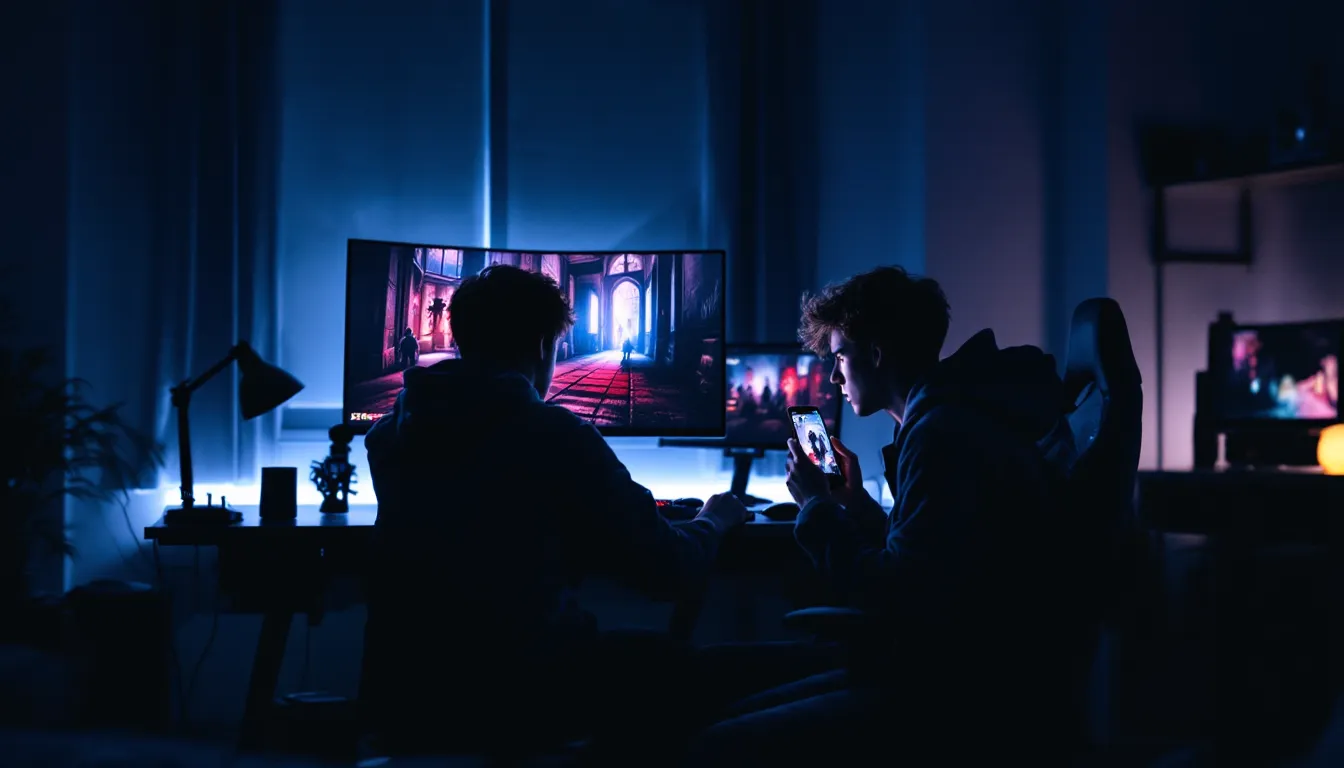

Roblox has become a goldmine for horror fans looking for genuinely unsettling experiences that actually hit different when you’re screaming at a friend instead of alone in your room. The platform’s explosion of user-created content means thousands of horror games drop every year, but the ones that truly nail the 2 player formula are rare. We’re talking about experiences where your buddy’s panic is just as entertaining as the jump scares, where communication breaks down exactly when you need it most, and where the real horror isn’t just what’s chasing you, it’s realizing your teammate just abandoned you in the dark. If you’re hunting for Roblox horror games that actually deliver on the multiplayer terror, you’ve come to the right place.
Key Takeaways
- 2 player Roblox horror games create unique psychological tension by forcing communication, trust, and coordination under genuine stress—elements that single-player experiences can’t replicate.
- Top-rated titles like Piggy, The Mimic, and Mansion of Madness succeed because they prioritize asymmetrical gameplay where each player experiences different roles, objectives, and challenges rather than identical tasks.
- Successful 2 player horror games use intentional design mechanics—from sound design and lighting to procedural map generation—to maintain fear and replayability across multiple playthroughs.
- Establish clear communication protocols and call-out systems before playing; compartmentalize fear from tactical execution, and study maps between runs to maximize coordination and survival odds.
- Choose 2 player Roblox horror games with active development, meaningful difficulty settings, and asymmetrical mechanics—these features ensure the experience stays fresh and engaging rather than becoming predictable or stale.
- Finding compatible teammates who share similar fear tolerance and humor alignment matters as much as skill; forming a core group of 2-3 consistent players dramatically improves coordination and long-term enjoyment.
Why Multiplayer Horror Games Matter
Horror is subjective when you’re alone. You can pause, breathe, mute the sound, you’ve got all the control. But the moment you add a second player, everything changes. Your fear becomes communal. Your reactions influence theirs. There’s a psychological shift that happens when you realize someone else is counting on you to not completely lose it.
Multiplayer horror games, especially 2 player experiences on Roblox, create a unique kind of tension that single-player games simply can’t replicate. You can’t just hide mentally: you’ve got to communicate, coordinate, and trust someone who’s probably just as terrified as you are. The best 2 player horror games exploit this dynamic ruthlessly, they design mechanics that force cooperation while simultaneously encouraging betrayal or panic. That asymmetry is what makes them stick with you long after you’ve finished playing.
What separates great 2 player horror from forgettable jump-scare simulators is intentional design. The games need to understand that having a buddy changes everything about how fear works. Some accomplish this through social deduction mechanics where you don’t know if your partner is trustworthy. Others use asymmetrical roles, one person is hunting, one is hiding. The best ones do both. On Roblox specifically, these games have the advantage of being free-to-play, meaning you can squad up with friends without financial friction, and the community is constantly pushing what’s possible within the platform’s building tools.
Top-Rated 2 Player Horror Games on Roblox
Piggy: A Social Deduction Nightmare
Piggy sits at the absolute top of Roblox horror rankings for good reason. At its core, it’s a 1v4 asymmetrical game, but the 2 player version cranks the psychological warfare up to eleven. One player becomes the infected hunter: the other is trying to escape. The trapped player has to solve puzzles, gather keys, and avoid being caught while the infected player is aggressively hunting them through procedurally generated maps.
What makes Piggy’s 2 player mode so brutal is the information imbalance. The hunter has limited vision but incredible speed and awareness. The hunted player can see more but has zero combat options. Communication becomes a mind game, do you tell your friend where you’re going, or do you go silent to avoid giving away your position if they’ve been infected? The game released its latest seasonal update in 2026 with new maps including “Mansion,” “School,” and “Temple” variants that have entirely different escape route layouts, so current playthroughs feel fresh compared to 2024 iterations.
The Mimic: Survival Through Cooperation
The Mimic flips the script on what 2 player horror can be. Instead of pitting players against each other, it forces genuine cooperation against an intelligent enemy that learns and adapts to your strategies. You and your partner are trapped in an environment with a creature that can copy anything it sees you do, sounds, movements, even your basic shape.
The game’s brilliance is that you can’t hide separately: the Mimic thrives on isolation. You’re forced to stay together, communicate constantly, and problem-solve under pressure. Maps change slightly between playthroughs thanks to randomized wall placements and item spawns, which keeps the meta from crystallizing. The current version (updated March 2026) added a “Nightmare Mode” that gives the Mimic access to player voice channels, meaning it can hear you planning and actually respond to your strategy calls. That’s genuinely terrifying and marks a significant difficulty spike from the 2025 build.
Mansion of Madness: Puzzle-Solving Terror
If your horror appreciation leans more “escape room” than “run for your life,” Mansion of Madness scratches that itch while maintaining genuine tension. The game emphasizes puzzle-solving and exploration over pure combat or evasion, but the atmosphere, achieved through meticulous lighting, spatial design, and sound layering, makes every room feel like a threat.
Two players explore a sprawling mansion, solving environmental puzzles to progress deeper. The horror escalates gradually: early puzzles are straightforward, but as you advance, the game starts introducing time pressure, false solutions, and actual creatures that patrol certain sections. The multiplayer component shines here because you genuinely need both players to solve certain puzzles, some require simultaneous button presses, others need one player to retrieve an item while the other guards a location. The game supports crossplay between PC and mobile platforms, which is rare for Roblox horror and makes finding a buddy easier if you’re gaming on different devices.
Escape Room Nightmares: Strategy-Based Horror
Escape Room Nightmares takes the escape room format and wraps it in genuine dread. Unlike pure puzzle games, this one maintains constant pressure through environmental hazards, rooms that flood, floors that collapse, hostile NPCs that patrol corridors. You’re not just solving puzzles: you’re solving them while the environment actively tries to kill you.
The 2 player version forces specialization. One player might be better at reading clues while the other has faster reflexes for timed sections. The game rewards different skill distributions rather than demanding identical ability levels. Recent updates added “Permadeath Mode” where dying once boots you from that run entirely, which completely changes how you approach cooperation. Players have documented on community forums that permadeath runs take roughly 45-60 minutes on intermediate difficulty, making them significant time commitments that amplify the stakes.
Specter Ops: Hide-and-Seek with a Twist
Specter Ops started as a team-based competitive game but has evolved a dedicated 2 player cooperative mode that’s genuinely underrated. One player is a ghost with special abilities: the other is a human investigator trying to survive and gather evidence. It’s fundamentally a hide-and-seek game, but with mechanical depth that prevents it from feeling shallow.
The ghost player has abilities like teleportation and fear projection but can’t directly harm the human. The human can set traps and gather clues that reveal the ghost’s location but is physically vulnerable. Both players need to understand each other’s capabilities to either succeed (cooperatively finding the truth) or fail (ghost eliminates the human). The asymmetry forces players to see the game from completely different strategic angles. Recent balance patches in early 2026 adjusted ghost ability cooldowns to prevent stalling, which shifted the meta toward more aggressive ghost play rather than pure hiding strategies.
Gameplay Mechanics That Make 2 Player Horror Work
Asymmetrical Gameplay and Role Distribution
The most successful 2 player horror games don’t ask both players to do identical things. Asymmetry creates depth. When one player is hunting and the other is hiding, they experience entirely different games simultaneously. The hunter needs map knowledge and tactical thinking: the fugitive needs stealth and resource management. Both are terrified, but for different reasons.
This design principle extends beyond simple role swaps. Some games create asymmetry through information access, one player sees threats the other doesn’t. Others use ability asymmetry where each player gets unique tools that don’t overlap. The best implementations use both. Games like The Mimic and Specter Ops understand that asymmetry drives replayability because you legitimately want to play both roles to experience the full game. Symmetric co-op (both players doing the same tasks) feels flat by comparison: it’s why games that tried pure “two people solving identical puzzles” haven’t aged well on Roblox since 2024.
Communication and Teamwork Under Pressure
Communication in horror games is its own stressor. You need to call out danger, share information, and coordinate actions, all while potentially panicking. The best 2 player horror games on Roblox intentionally create communication friction. Some do this through mechanics that require split attention: you can’t both watch the same area, so you’re constantly having to trust each other’s reports. Others introduce time pressure that makes complex verbal coordination impossible.
Piggy’s latest seasonal updates specifically added features that punish constant communication. In new map variants, the hunter can now detect movement sound from a certain distance, creating incentive for hunted players to go silent even when coordinating with teammates. This wasn’t in the 2024 version, which meant constant callouts were the dominant strategy. The mechanic forced players to develop non-verbal communication, specific meeting points, agreed-upon paths, fallback locations. It’s a small design tweak that massively increased strategic depth.
Teamwork breaks down under stress naturally: good game design accelerates that breakdown intentionally. The games that grip players hardest are ones where you have to actively fight against panic to function as a unit.
Atmosphere Building Through Sound and Visuals
Roblox’s graphics are inherently cartoonish, which means horror games can’t rely on visual realism. Instead, the best ones use lighting, spatial design, and sound to create dread. Darkness isn’t scary because it’s detailed: it’s scary because you can’t see what’s in it. That’s a sound design problem as much as a visual one.
Unusual audio cues, breathing sounds that aren’t yours, footsteps that aren’t timed right, ambient noise that shifts, create unease faster than jump scares ever could. Mansion of Madness excels at this: the game’s sound design creates a constant low-level anxiety that makes the actual threats feel more threatening when they appear. Games that rely purely on jump scares and loud noises feel exhausting after a while: games that build atmosphere through environmental audio feel scary after repeat playthroughs.
Lighting work on Roblox is underrated. Procedural shadows, flickering lights, and color shifts can suggest danger without showing anything explicitly. Some of the most terrifying moments in recent Roblox horror happen in well-lit rooms where something is wrong about the space itself, geometry feels off, NPCs move uncannily, proportions don’t make sense. That’s visual horror that doesn’t need graphical fidelity: it needs intentional design.
Tips for Playing Roblox Horror Games with Friends
Establishing Communication Before You Start
Setting expectations before you queue up saves misery. Discuss what you actually want from the experience. Are you here for scares or for mechanics? Does someone have a specific phobia you should avoid? How much toxicity is acceptable if one player dies due to the other’s mistake? These conversations feel awkward pre-game but prevent actual arguments mid-horror.
Establish call-out systems. Don’t rely on organic communication that breaks down under stress. Agree on specific terms: “Contact” means you’ve spotted a threat, “Clear” means your area is safe, “Rally point” means a designated meeting location. The games themselves won’t teach you this, and improvising in panic is how teams fall apart. Some players use Discord or team voice channels separate from the game audio, which helps because game audio sometimes muffles voice communication, especially in newer titles where ambient horror sound design intentionally obscures player callouts.
Talk about difficulty selection. Playing intermediate difficulty with someone who’s only comfortable on easy is a recipe for frustration. Roblox horror games let you set difficulty independently, so make sure you’re matching expectations.
Managing Fear and Staying Focused
Fear is contagious. Your panic will spread to your partner, which can actually spiral cooperative efforts. The most effective approach is compartmentalizing, acknowledge that something scary is happening, then refocus on the mechanical task at hand. You’re not trying to overcome fear: you’re trying to perform actions while afraid.
Mental discipline matters more than you’d think. Good players separate emotional reaction from tactical response. You can feel terror and still execute a planned strategy. Recent guides from gaming communities have documented that successful 2 player horror runs come from players who talk through what they’re about to do before it happens, creating cognitive friction that interferes with panic. It’s counterintuitive but effective.
Take breaks. Horror games are cognitively taxing in ways other genres aren’t. After a failed run or two, your pattern recognition deteriorates and panic response increases. Step away, reset, come back. You’ll perform better and enjoy it more. Grinding failed attempts back-to-back is how horror turns into frustration.
Coordinating Strategies to Survive and Escape
Strategy discussions should happen between attempts, not during them. Talk through what failed on the last run and why. Did you split up when you should have stayed together? Did someone miss a clue? Did panic override planning? Document what works. In games with procedurally randomized elements like Piggy or The Mimic, certain strategies are more flexible than others, identify which principles actually transfer between runs.
Designate a primary decision-maker for certain situations. If the hunter is closing in, does the hunted player make the call on where to hide, or does the team decide together? Too many cooks creates chaos: one person deciding under time pressure at least ensures decisiveness. Rotate who makes critical decisions between runs so both players get experience leading.
Study the map. Players who practice consistently recognize optimal paths, good defensive positions, and zones where threats are strongest. Allocate some runs purely to learning geography rather than trying to survive. Maps in current versions of Escape Room Nightmares have roughly 12-15 viable escape routes depending on which puzzles you solve in which order: knowing all of them puts you light-years ahead of improvising.
What to Look For When Choosing a 2 Player Horror Game
Game Design and Replayability
Replayability determines whether a game stays in your rotation or becomes a one-time experience. The best 2 player horror games use procedural generation, randomized enemy behavior, or multiple solution paths to keep repeat playthroughs feeling fresh. Piggy’s map variants mean the same escape scenario plays completely differently depending on which location loads. The Mimic randomizes obstacle placement and creature behavior patterns, preventing solutions from crystallizing into rote execution.
Check whether the game has seasonal updates or active development. Roblox horror games that stopped receiving updates in 2024 often feel stale compared to titles that got 2026 content drops. Stale games reveal their mechanics too quickly: once you understand how the threat works, fear evaporates. Games that evolve keep psychological pressure mounting because you’re not sure what to expect.
Look for games with difficulty modulation. The ability to adjust difficulty between runs lets you scale challenge as you improve, preventing the game from becoming trivially easy or impossibly frustrating. Games locked to single difficulty levels don’t age well.
Community Feedback and Player Reviews
Don’t just check star ratings: read what players actually say. Some games are rated highly by hardcore fans but are genuinely miserable for casual players. Others have community-reported issues that aren’t obvious from the description. GamesRadar+ has extensive guides and reviews that cover player feedback on popular horror experiences across multiple platforms, including discussion of which games work best for different skill levels.
Join the game’s Discord or community forums. Talk to people actively playing it right now. Ask specifically about the 2 player experience, not the general game experience. Some horror titles work great in solo or full teams but feel unbalanced with exactly two players. Pay attention to when people stopped playing and why. Games that lost their playerbase usually for good reasons.
Check whether the creator is responsive to feedback. Developers who patch exploits, adjust balance, and engage with the community tend to make games that improve over time. Devs who disappear tend to leave games broken. You’re making a time investment: you want it to pay off.
Difficulty Settings and Accessibility Options
Accessibility in horror games is tricky because discomfort is part of the point. But good design differentiates between mechanical difficulty and psychological torture. Some games let you adjust jump-scare frequency independent of enemy aggression, meaning you can reduce startling moments without removing challenge. That’s thoughtful design.
Look for games that let you mute specific audio cues or dim certain visual effects while keeping other gameplay elements intact. Some players have sensory sensitivities that make continuous high-pitched sounds or strobing lights physically painful. Games that accommodate this without removing the horror are rare but increasingly common. Twinfinite has tier lists and how-to guides that often break down which horror games on Roblox are more accessible for different needs.
Difficulty presets should feel meaningfully different, not just “enemy has 10% more health.” Good implementations scale enemy behavior, puzzle complexity, time pressure, and information availability based on difficulty. Nightmare Mode in The Mimic doesn’t just make enemies stronger: it fundamentally changes the game’s rules and information flow, creating a legitimately different experience from standard play.
Common Challenges in Multiplayer Horror Gaming
Balancing Fear Factor with Fun
Horror games live in a narrow band. Too terrifying and players quit: too safe and they get bored. The multiplayer component narrows that band further. Jump scares that feel scary in solo play can feel cheap with a friend who’s trying not to laugh. Enemies that are perfectly balanced in 1v1 might be trivial with coordination or brutal against uncoordinated players.
The best 2 player horror games accept that players will experience different emotional intensities and design around it. Some use difficulty settings to adjust scare frequency without removing stakes. Others lean into the absurdity, letting panic become comedy without removing the actual threat. Piggy sometimes hits points where the scenario is so ridiculous (you’re running from a pig) that players laugh instead of scream, but the mechanical tension underneath stays real.
Game designers call this “calibration.” It’s the hardest part of horror game development. You’re tuning fear itself, which is wildly subjective. A jumpscare that terrifies one player feels telegraphed to another. A creature that’s scary when first encountered feels non-threatening after 10 playthroughs. Successful games acknowledge this and structure themselves so that multiple experiences coexist. Experienced players find difficulty in mechanics and prediction: new players find difficulty in raw fear response.
Technical Performance and Lag Issues
Roblox games run on Roblox servers, which have quality variance. Some horror games run at smooth 60 FPS on potato hardware: others tank performance on high-end rigs due to poor optimization. Lag in horror games feels worse than lag in other genres because hitbox misalignment can make threats feel unfair. You got caught even though you thought you were clear. You pressed the button but it didn’t register. These feel like game failures rather than lag problems.
Check performance before you commit. Load into a private server or run a few maps in spawn to see how your hardware handles it. Roblox’s engine can be finicky, and some horror games push it harder than others. Mansion of Madness is known for occasional frame drops during heavy lighting effects: Piggy runs stable on almost any hardware. If you’re playing on WiFi, horrors that require precise timing are significantly harder.
Lag also breaks coordination. If you’re calling out danger but your friend hasn’t heard it yet due to network delay, you’re working on outdated information. Games with higher TTK (time-to-kill) forgive lag better than games where a single hit ends you. This is a technical consideration that affects playability more than people realize.
Finding Compatible Players and Consistent Groups
Finding someone to queue horror games with who actually vibes with your play style is harder than finding teammates for competitive games. Horror’s emotional component means compatibility is about fear tolerance, panic response, and humor alignment, not just mechanical skill. Two equally skilled players can be incompatible if one finds jumping scares hilarious and the other finds them traumatic.
Roblox doesn’t have a built-in grouping system like modern MMOs. You’re relying on your friend list or Discord communities. This creates friction because horror games are more enjoyable with people you trust. Playing with strangers means dealing with people who rage quit, give up emotionally, or treat horror as a place to be toxic without social consequences.
Build a core group. Find 2-3 people whose fear responses align with yours and who you can actually coordinate with. It takes time to develop actual teamwork in horror: one-off random partners rarely gel well enough to perform at their peak. Community discords for specific games help, but you’re still filtering through dozens of people to find someone compatible.
The Future of Roblox Horror Gaming
Roblox horror is evolving faster than most people realize. What’s happening in 2026 feels like the culmination of five years of experimentation. Early Roblox horror (2019-2021) was mostly jump-scare simulators. That era has definitively ended. Current games assume players have jump-scare fatigue and design around sustained dread, mechanical threat, and psychological manipulation instead.
AI is becoming a notable factor. Enemies that adapt to player strategy rather than following rigid patterns create fundamentally different challenges. Games released in late 2025 and early 2026 are experimenting with threat behaviors that learn from player tactics, making strategy-based gaming harder because solutions don’t persist across patches. This shift means horror games require ongoing learning rather than mastery of fixed mechanics.
Asymmetrical design is the current meta. Games that used to be 1v1 competitive are getting cooperative variants because developers realized asymmetry generates engagement both ways. Expect more games to offer both competitive and co-op modes using identical mechanics but different victory conditions. Destructoid’s coverage of emerging gaming trends has noted this shift across the horror genre broadly.
Crossplay and cross-device support are becoming baseline expectations. Roblox horror’s future involves seamlessly playing with friends regardless of whether they’re on PC, mobile, or console. This requires architecture rethinking but creates larger player pools and reduces friction for finding compatible partners.
The technical ceiling on Roblox is being pushed. Lighting, physics, and sound design are reaching levels that would have been impossible two years ago. Future horror games will leverage these improvements to create atmosphere that currently feels out of reach. Games published in 2026 already look generationally better than 2024 titles in terms of environmental ambiance and spatial design.
Conclusion
2 player Roblox horror games occupy a unique space, they’re accessible to anyone with an internet connection and a friend, yet mechanically sophisticated enough to engage veteran gamers. Piggy, The Mimic, Mansion of Madness, Escape Room Nightmares, and Specter Ops represent the best current implementations of what multiplayer horror can achieve on the platform, but they’re far from the only quality options available.
What separates good 2 player horror from forgettable ones is intentional design around the multiplayer component. Asymmetry, forced communication, atmosphere building, these aren’t afterthoughts. They’re central to how fear works when you’re experiencing it alongside someone else. The games that understand this will stick with you long after you’ve finished playing.
Start with one of the top-tier titles depending on what you actually want. If you prefer social deduction and betrayal, Piggy is unmatched. If you want cooperation against an intelligent threat, The Mimic delivers. If puzzles are your speed, Mansion of Madness hits. The important part is finding something that matches your fear tolerance and skill level, then actually committing to repeated playthroughs so you can develop real coordination with your partner. Horror games reward familiarity: the second run is always less scary than the first, but it’s often more fun because you’re not just surviving, you’re executing strategy.